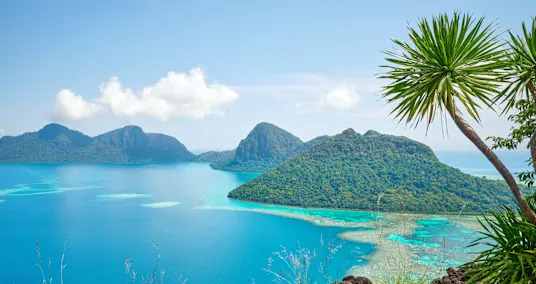
Southeast Asia has it all. From sprawling, chaotic cities with unmatched street food to rainforests and ancient ruins, it's the stuff of travel dreams. But there's nowhere more revered than its tropical islands. Numbering over 25,000 across the region, its impossibly beautiful slices of sand-fringed heaven cater to everyone from backpackers to high-end luxury travelers.
Thailand and Indonesia practically dominate that space in the minds of most travelers, with islands like Bali, Phuket, and Koh Samui making up just a few of the most famous. But between these two travel powerhouses lies Malaysia, arguably one of the most underrated countries in Asia by Western standards. It's known primarily for its modern capital, Kuala Lumpur, but it has its own swath of beautiful islands perfect for a vacation that won't break the bank.
But Malaysia isn't a secret to others on the continent. Millions of tourists still hit its shores, crowding some of the more popular spots like Langkawi and Penang, especially on big holiday weeks. So opting to check out some of its lesser-known islands can go a long way to making your visit unforgettable. From private island resorts to wonderfully undeveloped village experiences, these under-the-radar Malaysian getaways are worth considering instead of Thailand or Indonesia.
Read more: 25 Gorgeous Islands For Vacationing That Won't Break The Bank
Pulau Sibu, Johor

Despite still being one of Malaysia's hugely underrated tropical islands, Tioman is the dominant tourist force just off the peninsula's beautiful southeastern coast. Drawing visitors for weekend getaways from the city to take advantage of the stunning beaches and enjoy a drink at lower prices, thanks to the duty-free laws, it can get busy.
Pulau Sibu ("pulau" simply meaning island) represents the perfect alternative. Tiny in comparison to Tioman, the main island (of which there are four), is just 3.7 miles long and around 0.6 miles wide. But the diverse island packs a lot into its compact space. Snorkeling and scuba diving remain the primary draw here, as it's part of the broader Sultan Iskander Marine Park, boasting incredibly clear waters and abundant marine life. Sibu itself is a jewel within the park, owing to its millions-of-years-old volcanic rock beaches, where you can explore sea caves and even bathe in the rock pools. The interior of the island is covered in dense jungle, with brilliant paths carved out for hikes, where you can spot everything from wild boar to water monitors. There are also multiple sandy beaches to kick back on and mangrove forests to admire.
Sibu is dotted with character-laden resorts, but don't expect high-end luxury. The best reviewed options are the 4-star Rimba Dive Resort and the Sea Gypsy Village Resort and Dive Base. Many people stay here to complete their Padi certificates, but that's not a requirement. To get to the island, you'll need to get to Tanjung Leman Jetty in Johor. Most of the resorts offer direct ferry services from there, so it's best to contact your specific accommodation.
Pulau Aur, Johor

Further east, but still located within the same Sultan Iskander Marine Park, is Pulau Aur. It's even less developed than Sibu, with only a couple of resorts setting up shop on its sandy shores. As the furthest point east on Peninsular Malaysia, it enjoys some of the clearest water in the region, drawing adventurous divers to its shores to check out the coral reefs and local sea life, including mantas, blacktip sharks, and barracudas. But that distance does mean it's a little harder to get to. With incredible visibility up to about 230 feet (70 meters), it's a special opportunity.
After making the two-hour speedboat journey from Mersing Pier in Johor — again, typically pre-booked with resorts instead of public ferries — guests are greeted with a gloriously undeveloped island, ripe for exploration. Some of the resorts, like The Rock Resort, are getting more modern, but several are still as humble as can be. That means you can expect to find no air conditioning, no WiFi, and maybe not even warm water in some cases, depending on where you stay. But you'll still be able to relax on a perfect beach at the end of a long day exploring.
There aren't any roads on the island, so if you want to explore the interior, get up to its stunning Raynor's Rock, or visit the kampungs (traditional villages) at the back of the island, you'll need to lace up your boots and get trekking. You might even come across the remnants of a Australian military plane crash in the center of the island. Divers can also find the wreckage of a Japanese World War II ship.
Pulau Rawa, Johor

Sticking to the same Southeastern region, Rawa Island offers yet another contrasting experience to Tioman, but unlike the first two on the list, Rawa homes in on exclusivity instead of adventure — not that you can't find it there. Where it differs greatly is the fact that it's owned and operated on a private basis. To be specific, it's owned by the Sultan of Johor, who still uses it for state functions and other events. Found just about 10 miles from the Johor coast, it's the easiest of the islands to access so far.
Life on Rawa is slow, and that's what visitors head there for. You won't find a ton of nightlife, but you will find perfect white sand, coral reef snorkeling opportunities straight off the beach, and stunning jungle walks around the island. There's no fishing here, as it's a protected ecosystem, so if you're in search of some sport reeling, you'll need to head to one of the defined islands for that activity.
Of course, with that exclusivity, you're not going to be going on a budget. There are only two resorts on the island — the all-inclusive Rawa Island Resort and upscale chalets at Alang's Rawa, and they're both going to stretch your wallet compared to many other Malaysian destinations. With that said, when comparing to other similar beach spots around the world, $100 per person per night isn't a bad deal for full board. You'll only be able to get there via a prearranged speedboat from Mersing, which will likely be included in any resort rates.
Pulau Tinggi, Johor

The last entry from the Johor coastal region is Pulau Tinggi, a spectacular conical hat-shaped haven. Living up to its name ("tinggi" is translated as "high"), the approach to the island is special. Created by a now-extinct volcano, the island rises over 2,100 feet above sea level to the peak of Mount Semadu. Tinggi feels wilder and less manicured than its neighbors, and it's remained well off Western tourists' radars besides some intrepid diving enthusiasts.
One of Tinggi Island's greatest draws is its numerous waterfalls, many of which can be hiked to and enjoyed as a private pool. The hikes themselves are more challenging than others in the area. The combination of serious incline and dense rainforest make for an adventurous time, but make sure you speak to employees at the resort to gauge safety, or join in an organized trek through your hotel. It's also worth checking out the nearby stilted fishing villages, built over the water, where locals still live.
The island isn't dominated by resorts, but there are a few great options that will let you stay comfortably and have a great place to rest your head after an adventurous day out snorkeling and diving, in addition to hiking. If you're looking to pull hard off Malaysia's beaten path, this is the place to do that. It balances isolation and access well, too, being closer to the mainland than others but less developed.
Pulau Kapalai, Sabah

Technically speaking, Pulau Kapalai isn't really an island anymore. As recently as a century ago, it was a lush island similar to many others off the coast of Sabah on Malaysian Borneo, but today it's no more than a sandbank at low tide with luxury chalets built atop. Still, it's got Pulau in its name, it's an unbelievable place to visit, and so it makes the list.
There's only one property on Kapalai, the Sipadan-Kapalai Dive Resort. Operating for over 35 years, the hotel has become something of an icon in the Sabah tourist scene. Setting itself up as Malaysia's answer to the Maldives, the overwater villas are a dream, offering a luxury experience for those looking to dive or just chill out in the middle of the Celebes Sea. It's in close proximity to Sipadan, Malaysia's only Oceanic island, and rated as one of the world's best diving destinations for underwater beauty, and Mabul, the world's top "muck diving" destination and home to sea-faring nomads, nicknamed the Bajau Laut. In practice, there's no real beach either, but you can sunbathe on the sandbar when the tide drops.
For those unfamiliar with Malaysia's geography, Kapalai is far removed from the Peninsula mainland. Located on the eastern side of Borneo, it's closer to the Philippines' capital, Manila, than it is to Kuala Lumpur. It won't be a cheap trip getting there or staying, but for those who venture out, it's an unforgettable experience with a surprising cultural side, thanks to the nearby islands.
Pulau Perhentian, Terengganu

The Perhentian Islands are undoubtedly the best known of the islands on this list. And while they're definitely getting more attention than before, they've held on to their hidden gem atmosphere in a number of ways. Found off the coast of the state of Terengganu — back on Peninsular Malaysia's northeastern coast, they're easily accessible by grabbing a ferry from Kuala Besut. Unlike the others on this list, these ferries are public, so you don't need to prearrange your travels. Just let them know which resort you're getting off at.
There are three main islands in the group, with Perhentian Besar and Kecil (Greater and Lesser) being the only inhabited ones, with some other tiny ones that can be visited on snorkeling trips. Kecil, the smaller island by a small margin, is generally the most popular island. Its laid-back vibe, with easy-going resorts, and a chilled beach bar scene, centered around picturesque Long Beach, draws backpackers and families alike. Staying on Long Beach keeps you central, but with multiple resorts and stripped-down chalets dotted around the shoreline, there's a decision to be made here. Water taxis can get visitors around easily, or they can venture along the dense rainforest paths. Besar is a simpler affair, with some higher-end family-oriented resorts. Again, it's super easy to grab a taxi to Long Beach's "vibier" climes, so don't worry too much about which you pick.
Just be wary of the timing of your visit. Resorts will still be open in October, but it's regarded as a transitional month where the oncoming monsoon season can see the typically sunny days replaced with longer periods of rain and some spectacular storms. It will be quieter and cheaper, though, so it might be worth the risk.
Pulau Lang Tengah, Terengganu

Pulau Lang Tengah sits between Redang and the Perhentians — and somehow gets forgotten because of it. That's a travesty in its own right (or a blessing) because it delivers the same turquoise water and reef access without the armada of snorkel boats and peak-season chaos. You'll reach it by speedboat from Merang Jetty, and within an hour, the mainland feels like a different country. It's not dramatic or flashy on arrival. It's just blue water, soft sand, and a sense that you made the smarter booking.
Development here hits the sweet spot. There are a few mid-range beachfront resorts with comfortable chalets, proper meals, cold drinks, but none of the mega-resort sprawl you'll find on Langkawi and other stretches of the mainland. The real draw is how easy the reef access is. You can step straight off the sand into clear, fish-packed water during the March to October season, with coral gardens that rival the bigger-name islands nearby. Diving is available, but Lang Tengah is better for just snorkeling and enjoying long, lazy afternoons under the palms with no schedules and no competing for beach chairs.
What makes Lang Tengah stand out is the balance. It doesn't cater as much to backpackers like Perhentian Kecil often can, and it doesn't feel packaged like parts of Redang. Families, couples, and small groups come here because it feels relaxed without being dull. There's enough infrastructure to make things easy, but not so much that it feels curated or overblown. If you're comparing Thailand or Indonesia's headline islands and assuming Malaysia can't compete, this is the place that proves otherwise. It's a real taste of what some of the Thai islands were like 20 years ago.
Pulau Penang (The Other Side), Penang

Surely one of Malaysia's tourist jewels couldn't feature as one of the country's most under-the-radar destinations? On face value, probably not. Georgetown, the island's UNESCO-protected cultural highlight, is one of the most visited places in the country, and one of the best islands to visit in the whole of Southeast Asia. But for foreign tourists, the far side of the island remains more elusive.
If you can pull yourself away from the Old Town's culinary delights, the northern and western coasts of the island offer a more traditional island escape. Batu Feringghi, a resort town just about 9 miles from Georgetown, offers all the trappings, from watersports on the well-kept beaches, waterfront beach bars with buzzing nightlife scenes, and it even serves as a solid jumping-off point for some epic waterfall hikes. Following the coast along, you'll find Penang National Park, Malaysia's smallest. Despite its size, it offers some breathtaking hikes through monkey-run beaches, rainforest canopies, and glorious clifftop views. Further south, if you're adventurous enough to get there, you'll find the wide-open expanse of Pantai Pasir Panjang, or Long Sand Beach.
Penang is too often treated only as Georgetown (which is most definitely worth the hype), but there's an expansive island with outstanding beaches and traditional seafront experiences you might not find in Malaysia's more remote islands. After all, not everyone is content sitting in the sand for a week, especially if there are jet skis waiting for them. Visit Penang, get your fill of the UNESCO sites, then step out into the rest of this remarkable island.
Pulau Pangkor, Perak

Pulau Pangkor's relative anonymity is as wondrous as the island itself. Under four hours by car from Kuala Lumpur, Malaysia's largest city and melting pot of Southeast Asia, it's one of the few islands that's in true striking distance without grabbing a flight or overnight bus to the nearest jetty. It's another of Malaysia's duty-free islands (a big deal considering the cost of alcohol in the country), but its draws are much broader than a cheap beer. You can almost split the island into two: the traditional Pangkor and the luxury-focused Pangkor. And whether you're opting for one or straddling the experience, it's worth the trip.
Luxury resorts like Pangkor Laut represent the best of high-end Malaysian hospitality — it was literally named best in the world at one point — with some of Malaya's most beautiful over-water bungalows, tremendous food, and nature-focused ethos. But rates aren't sky-high across the island. There plenty of wonderful accommodations running the full gamut of price points. Elsewhere, coastal strips like Coral Beach offer sandy-toed days in the sun, and while snorkeling may not be as good as on the East Coast, Pangkor makes up for it with immense cultural draws. Its fishing villages are an authentic slice of island life in Malaysia, and the ruined Dutch fortress is an excellent piece of the Straits of Malacca's complex colonial history.
Pangkor is arguably the best-rounded island on this list from an experiential level, offering history, luxury, and budget accommodation, great beaches, amazing seafood, and unique cultural experiences. Plus, that proximity to Kuala Lumpur means it's reachable without too much of a headache — something that can't be said for the more remote islands featured here.
Methodology

This article was written using a combination of well-regarded travel media sites, local bloggers, and personal experience. I live in Malaysia and have visited most of these islands, barring those on the far east of Sabah. They were chosen for their relative obscurity compared to the more popular islands of Langkawi, the other side of Penang, Tioman, and others, while offering what I feel is a comparable experience to the beach islands of Thailand and Indonesia. Any factual statements are backed up by online resources.
Ready to discover more hidden gems and expert travel tips? Subscribe to our free newsletter and add us as a preferred search source for access to the world's best-kept travel secrets.
Read the original article on Islands.
latest_posts
- 1
 World's oldest known tortoise still very much alive despite rumor to the contrary
 - 2'Spending more on gas than groceries:' Rising fuel prices drive more San Antonio families to the Food Bank amid Iran war
- 3Pick Your Number one Sort Of Music
- 4Woman leaves bachelorette trip after trusting her gut about sketchy men partying it up with friends
- 5Sanofi to acquire hepatitis B vaccine maker Dynavax for $2.2 billion



- Skeleton of famed musketeer possibly found in Dutch church
- After harsh winter, Ukrainians find joy in releasing bats rescued from war
- Manual for 6 well known Amusement Park
- Netanyahu leads meeting on West Bank riots, Katz defends axing administrative detention for Jews
- Aid sent by ambulance to Ukraine front line
- Denny's is shutting down restaurants around the country. What's behind the closures?
- Vote in favor of your Number one method for praising a birthday
- 4 Famous Attractions at Disneyland
- India's top court hears challenges to ruling on women's entry into temple