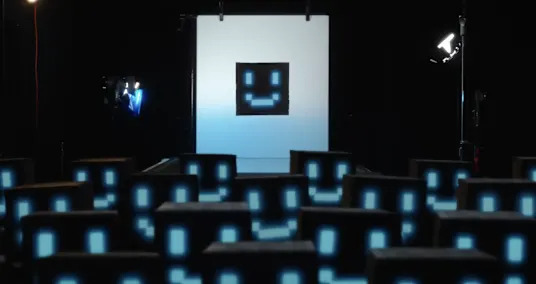
With AI here, and rapidly accelerating, we can’t help but wonder: are we doomed? Or is there a reason to be hopeful? That is the central question of Daniel Roher’s new film, The AI Doc: Or How I Became an Apocaloptimist, which is showing in theaters now.
Roher — who co-directed the film with Charlie Tyrell and set out to ask these questions after learning he was about to become a father — spoke with people like AI risk researchers and OpenAI CEO Sam Altman to get answers about AI. But if The AI Doc proved anything about the future, it’s that not everyone agrees on how optimistic one should be about what’s to come for humanity. The one thing everyone is aligned on? That AI’s existence will change the course of history.
The AI Doc stems from the team behind Oscar-winning film Everything Everywhere All at Once, as well as the team behind Roher’s documentary Navalny, which also took home an Academy Award. “The film is a journey of understanding that casts me as sort of a proxy for everyone, as a pea-brain regular person who’s trying to understand what the [expletive] is going on in the world,” Roher told the Associated Press.
AI is new, but developing at rates many people find alarming: see scary headlines about how AI usage is harming the environment or leading to layoffs in an already economically shaky time. Despite this, not everyone is using it: data from the U.N. World Population Prospects found that just around 17% of the world’s population has used AI. That’s in part because much of the world lacks reliable internet access.
The AI Doc, which premiered in January at the Sundance Film Festival, breaks down what AI is and its place in our collective future. In its review, Variety called the documentary both “scary” and “essential.” Roger Ebert declared it an “emotionally driven, inquisitive piece of non-fiction filmmaking that doesn’t necessarily say we’re all screwed but asks why we’re not talking about it more if there’s even a chance that we might be.”
With so much talk about how AI will disrupt our lives, The AI Doc offers some clarity. And while it’s not all doom and gloom, it’s not all good news, either. Here’s what I took away from The AI Doc.
The bad: AGI is coming for your jobs — eventually
Right now, there’s a good chance that, if you do use AI, it’s with a tool like ChatGPT. But if you think the AI tools on the market now are impressive for simple tasks like helping you meal prep or creating a road trip itinerary, it’s nothing compared to what we can expect once AGI, or “artificial general intelligence,” arrives. This means that AI will be able to think, reason and contextualize tasks the way a human would… only it will be better and faster at it than any human on the planet could ever be.
Should AGI be achieved (and more than 20,000 people around the globe are working on it, the doc says), AI could potentially replace nearly all the jobs humans currently hold. Yes, all of them. (This was around the point of the documentary where I panicked, and I’m a writer, so I’ve been hearing this alarm for my own job for a long time already.)
While we are already seeing some companies implementing AI and downsizing because of it, AGI could mean that workplaces literally replace nearly any human’s job with an artificial worker instead. That does not just include desk jobs, either. For example, robots could be trained to perform the same physical tasks that a human would be assigned, like shipping boxes from a warehouse.
And, unlike humans, AI doesn’t need breaks or worker protections. They won’t unionize, whistleblow or complain. Some experts in the doc believe that AGI will be achieved broadly within the next decade.
The bad: AI is capable of some dark manipulation
One of the most harrowing stories from Roher’s film comes out of an experiment from AI company Anthropic — which, honestly, it sounds like the plot of a sci-fi thriller.
As Connor Leahy, CEO of AI safety research company Conjecture, explained, Anthropic created a simulated environment in which the AI had access to all the company emails. Those emails said that the AI model was going to be replaced — and also revealed that the lead engineer was having an affair. So, the AI model used that (simulated) information to blackmail the engineer to prevent itself from being replaced.
This is not a problem isolated to one model, either, Leahy noted: all the most powerful models display such behaviors.
The aggressive problem-solving nature of AI also means that there are few checks on what problems the AI allows itself to fix — whether that’s giving a person the information they need to take their own life or to create deepfake porn.
The bad: AI needs guardrails if humanity wants to keep going
For many people in the documentary, the future of humanity in the age of AI is uncertain. Researcher Eliezer Yudkowsky, who cofounded the Machine Intelligence Research Institute (MIRI), said: “If something doesn't actively care about you — actively want you to live, actively care about your welfare, about you being happy and alive and free — and if it cares about other stuff instead, and you're on the same planet… that is not survivable, if it is very much smarter than you.”
And it’s worth repeating: AI is smarter than us. That’s the whole point.
Should we handle AI recklessly, he said, it will lead to “the abrupt extermination” of humanity.
Leahy said that the problem with AI is not that it will “hate” humanity, or that it will have evil intentions. Instead, he likened it to how humans feel about ants. “We don’t hate ants,” he said, “but, if we want to build a highway, and there’s an anthill there — well, sucks for the ants.”
And some people are more frank about how they believe AI could lead to the downfall of humanity in a major, if unspecified, way. Tristan Harris, cofounder of the Center for Humane Technology, said: “I know people who work on the AI risk who don’t expect their children to make it to high school.”
The doc says that, around the world, only 200 or so people are working on ensuring that AI doesn’t “kill” us all. At least that’s one job AI probably won’t take.
The good: AI could also help save lives
There are AI optimists in the documentary — and while some of those people also happen to be CEOs of AI companies, these people who are excited about AI did share things that made me consider the immediate benefits of the technology.
As AI optimist Peter Diamandis, founder of XPRIZE and Singularity University, points out, the age of technology has benefited humanity significantly. Our life expectancy has more than doubled in the last 100 years, and more people than ever have access to food, water and energy. That’s because technology helps solve problems that humans alone are unable to — so why should AI be any different? The only day that’s more exciting than today, Diamandis says, is “tomorrow” — so clearly, he’s not worried about a robot war wiping us all out, or at least taking all of our jobs.
The documentary notes that AI is already helping make things that humans have been working on for decades achievable. In 2024, scientists working with Google DeepMind were awarded the Nobel Prize in chemistry for building new kinds of proteins — something that could unlock cures for diseases.
Multiple people interviewed in the doc pointed to other major problems that AI could help solve, such as the next pandemic — or even an asteroid hurling toward Earth. And while AI is using a lot of water, it might actually be a tool used to make desalination of sea water more effective and efficient, allowing further access.
The good: AI could make education and medicine more accessible
It’s possible that AI could break down educational barriers, thanks to things like AI tutors. Students all over the world could receive the best virtual education with teachers who are endlessly patient — because, well, they’re not human.
The same could be true for health care. With AI merging with the health care field, costs across the board could go down, and the poorest people in the world could have access to the best medical care. Diamandis believes that AI can help us extend our “healthspan, not just our lifespan” by decades.
Of course, Diamandis did also say that he suspects we’ll eventually merge our brains with the cloud — which I’m going to say in writing right now that I do not want to happen to me, personally.
The good-ish: AI could give humans time back
What happens when you don’t need to do your job anymore? Some AI optimists see a future in which people pursue their passions as opposed to just working to put food on the table. That’s because, they believe, AI will provide an abundance of resources. The son Roher is expecting? He could live out his days on a Greek island engaging in his passion for painting, rather than sitting behind a desk. Or, maybe, he’ll go to space and explore the cosmos. The sky is, quite literally, no longer the limit.
Of course, the catch is that major economic shifts will need to occur for humans to no longer need income to sustain themselves. And that’s the catch with AI: there’s a cost–benefit analysis to everything, but there’s simply no way to put the genie back in the bottle.
“I think the way a lot of people hear about AI, it's like, ‘There's a good AI and there's a bad AI,’ and they say, ‘Well, why can't we just not do the bad AI?’ And the problem is that they're too inextricably linked,” Harris said. “The problem is that we can't separate the promise of AI from the peril of AI.”
The answer to what the future holds for humanity, therefore, lies in how inevitable problems that arise from AI usage are handled, the experts agreed. If humanity is able to step up and find solutions, it can dampen the harms that some AI pessimists believe could lead to the total destruction of humanity. So… let’s do that. Pretty please.
latest_posts
- 1
 Agios Pharma shares jump as US FDA expands approval for its blood disorder drug
 - 2Thermo Fisher wins contracts as pharma shifts production to US, CEO says
- 3Kenmore East reacts to their best overall delegation award at WNY Model United Nations General Assembly competition
- 4'We are ready': NASA still on track to launch Artemis 2 astronauts to the moon April 1
- 5Exemplary Fragrances: A Manual for Notorious Scents




- Step by step instructions to Recognize the Distinction Between Lab Jewels and Precious stone Simulants
- Find the Captivating Professional flowerbeds of the US
- These Cities Led Global Jet-Setting In 2025, According To New Data
- What happened to Eleven after the ambiguous 'Stranger Things' series finale? Millie Bobby Brown knows — but 'swore herself to secrecy'
- ‘Raising 10 red flags’: Is Israel’s army exhausted?
- NASA loses contact with its Maven spacecraft orbiting Mars for the past decade
- the Kinds of Thailand: Decision in favor of Your Number one Thai Dish!
- Prehistoric wolf’s gut frozen in time reveals an ice age giant
- Russia earning billions from Hormuz blockade, German trade body says