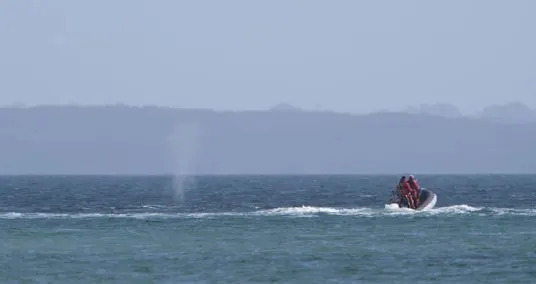
Conservationists continued rescue efforts on Friday to guide a humpback whale recently freed from a sandbank off Germany's Baltic Sea coast.
Teams used inflatable boats in Lübeck Bay to escort the whale, which had been stuck near Timmendorfer Beach since Monday, toward deeper waters.
The marine conservation groups Sea Shepherd and Greenpeace said their boats are in the water to try to keep the whale away from the beach.
At times the humpback whale had been heading back towards shallower water, a Sea Shepherd spokesman said.
Using the inflatable boats, the organizations had created a kind of blockade to stop it from returning to shallow water.
The whale had freed itself early on Friday from a sandbank off of Germany's Baltic Sea coast and was heading out of the Bay of Lübeck, a marine scientist said. It had been stuck there since Monday.
No transmitter was attached to the whale because its skin was too badly diseased.
latest_posts
- 1
 Instructions to Boost Your True capacity with a Brain research Degree
- 2Displaced Palestinian families suffer as heavy rains flood Gaza tent camps
- 3German Court Rejects Bid To Force BMW and Mercedes-Benz To Stop Selling New Combustion-Engine Cars After 2030
- 4Four Dead in Last Month From Animal Attacks in Nepal
- 5What's the new 'Knives Out' mystery about? Everything to know about 'Wake Up Dead Man,' including who's in the cast and what the reviews say.





- Discovering a sense of harmony: Individual Accounts of Reflection and Care
- Director of Swiss hospital describes the rush to treat the injured from Alpine resort bar fire
- Qantas and Virgin Australia Ban Power Bank Usage on Flights Following Safety Incidents
- Elite Execution Wall televisions for Film Darlings
- Lightning on Jupiter could be up to 1 million times stronger than on Earth
- Germany's far-right AfD tops poll ahead of Merz's conservatives
- ‘This year nearly broke me as a scientist’ – US researchers reflect on how 2025’s science cuts have changed their lives
- German Winemakers Rewrite The Rules Of Riesling In A Warming World
- James Webb Space Telescope's mysterious 'little red dots' may be black holes in disguise