When you buy through links on our articles, Future and its syndication partners may earn a commission.

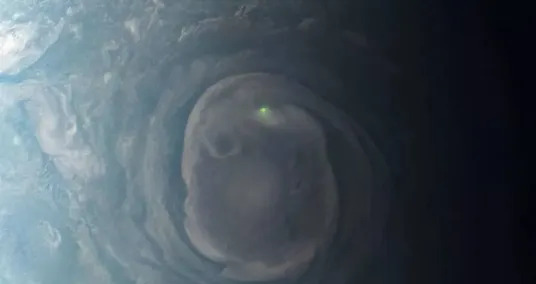
Lightning on Jupiter may pack more than 100 times the power of Earth's bolts, and may even prove to be one million times stronger, a new study finds.
Jupiter, the largest planet in the solar system, has correspondingly gigantic storms, with some of these lasting for centuries. Nearly every spacecraft that has passed by Jupiter to date has detected lightning, with flashes visible on the planet's night side.
Based on missions that could only detect the most powerful dark-side flashes, previous research had suggested that Jupiter's lightning was similar to the highest‐energy lightning flashes on Earth, known as "superbolts." However, when NASA's Juno spacecraft began orbiting the giant planet in 2016, its star-tracking camera was sensitive enough to detect what appeared to be numerous weaker, Earth-like flashes.
The problem with night-side imaging of Jupiter is that its clouds can obscure the view of lightning flashes. This can make their true power difficult to estimate, explained study lead author Michael Wong, a planetary scientist at the University of California at Berkeley.
In the new study, Wong and his colleagues instead analyzed data from Juno's core instrument, which could detect radio emissions from Jupiter's lightning. Such data could yield a more precise way to measure lightning power unaffected by obscuring clouds.
A challenge the researchers faced was how Jupiter often experiences multiple storms at the same time across belts that encircle the planet. This can make it difficult to pinpoint which storm produced any lightning Juno detected. Wong compared this problem to hearing a series of pops at a Chinese New Year's parade and not knowing if it was exploding popcorn a few feet away or firecrackers a block away.
However, in 2021 and 2022, there was a lull in storms in Jupiter's north equatorial belt. This let the scientists focus on just one large storm at a time, pinpointing its location using NASA's Hubble Space Telescope, Juno and images from amateur astronomers. Wong called these "stealth superstorms." Similar to Jupiter's true superstorms, their activity lasted for months, but unlike true superstorms, their cloud towers only reached modest heights.
Juno was close enough to four of these stealth superstorms to analyze microwaves from their lightning.
"It was so gratifying to work through the statistics and see that with our Juno data, we were really capturing the majority of lightning pulses at radio wavelengths," Wong told Space.com. "Before, there was some question about whether we might be catching only the strongest pulses and missing weaker ones."
The flashes the researchers detected averaged three per second during these flyovers. From 613 pulses measured, they calculated they ranged in power from about that of an Earth bolt to 100 or more times more powerful.
The scientists cautioned there were uncertainties in their estimates because they compared Earth lightning emissions at one radio wavelength to Jupiter emissions at a different wavelength. Jupiter's bolts may actually be a million times stronger than Earth's, they said.

Jupiter's lightning could help explain how its atmosphere and storms operate. Similar to Earth, Jupiter experiences convection — churning that transports heat from below.
Wong explained that convection on Jupiter operates differently than on Earth because air on Earth is mostly nitrogen, which is heavier than water, so moist air is more buoyant than drier air. In contrast, Jupiter's atmosphere is dominated by hydrogen, so moist air is heavier and more difficult to loft upward. This in turn means it takes a lot more energy for a storm to rise on Jupiter, and that it unleashes a lot more energy if it does reach the top of the atmosphere, leading to high wind speeds and intense lightning.
The researchers suggested that lightning on Jupiter is likely generated much like it is on Earth, with rising water vapor condensing in higher, colder altitudes into liquid drops and ice crystals that get electrically charged. However, Wong noted that it remained uncertain why Jupiter's lightning was more powerful.
"Could the key difference be hydrogen versus nitrogen atmospheres, or could it be that the storms are taller on Jupiter and so there's greater distances involved?" Wong said in a statement. Jupiter's storms are more than 62 miles (100 kilometers) tall, compared to 6.2 miles (10 km) on Earth. "Or could it be that greater energy is available because with moist convection on Jupiter, you have a bigger buildup of heat needed before you can generate the storm to create lightning?"
The scientists detailed their findings March 20 in the journal AGU Advances.
latest_posts
- 1
 We may have less control over how long we live than previously thought
 - 2Kelsey Grammer on having a new baby at 70: 'You're just more available now'
- 3Pick Your Favored kind of sandwich
- 4Authorities Bust Camel Booze Smuggling Operation, Seize Nearly 2,000 Containers of Illegal Alcohol
- 5New trailer for 'Bridgerton' Season 4 teases Benedict's love story: Watch it here





- Rick Steves' Newest Guidebook Is A Fresh Perspective On Italy Spilling The Country's Secrets
- Ukrainian Army Converts E38 BMW 7-Series Into Multiple Rocket Launch Platform
- Watch the Geminid meteor shower peak tonight from the comfort of home with this free livestream
- New images reveal interstellar comet 3I/ATLAS approaching Earth
- 'We are ready': NASA still on track to launch Artemis 2 astronauts to the moon April 1
- 'The best gift ever': Baby is born after the rarest of pregnancies, defying all odds
- Artemis II live updates: NASA's moon mission breaks Apollo record for farthest distance humans have traveled from Earth
- Most loved Occasion Dish: What Makes Your Merry Table?
- Overlooked infertility care should be part of national health services, says WHO